Your comments


Hi, thanks for using Hebcal, and thanks for your question!
If you'd like multiple things to show up on a printed calendar (such as Jewish holidays and also local national holidays ), we recommend downloading/exporting from hebcal.com and importing into a more full-featured desktop or web calendar program, such as Google Calendar, Outlook, or Apple Calendar.
https://www.hebcal.com/home/38/printing-a-jewish-calendar
If you're a software developer, you'll find many of our APIs described here.
https://www.hebcal.com/home/developer-apis
In particular, if you are trying to display a Jewish calendar on your website, we recommend using fullcalendar.io
Hi, thanks for using Hebcal, and thanks for answering your own question!
We recently made changes to the annual email reminders message. You will now find an “Edit Yahrzeit” link at the bottom of the reminder email message.
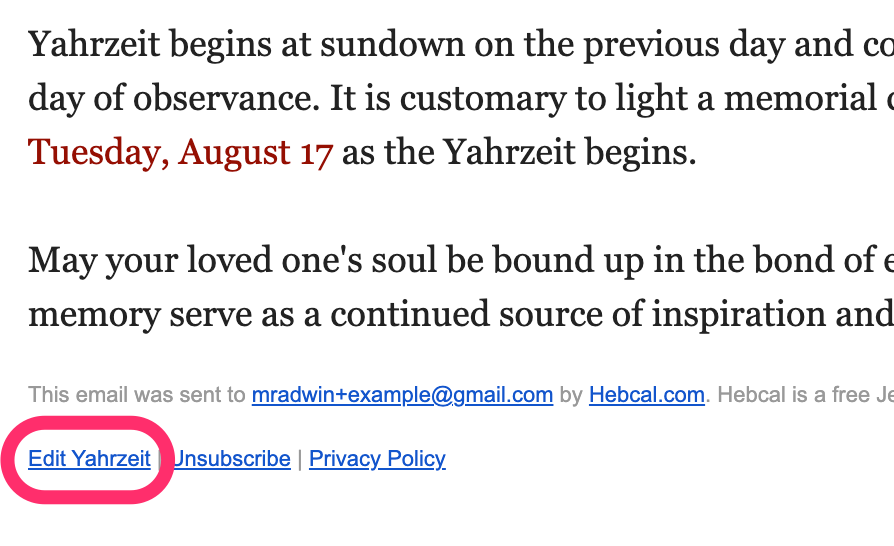
We have also written a brief summary and posted in the Help section of the website.
https://www.hebcal.com/home/632/how-to-make-changes-to-a-yahrzeit-anniversary-calendar
Shana Tova!

Excellent suggestion! And a great solution to the problem you describe. We can add that to our feature request backlog.
I didn't realize you were looking for an API. If you've got some software engineering expertise, you can do this even more easily in JavaScript using the @hebcal/core package.
const {Sedra} = require('@hebcal/core');

for (let year = 5677; year <= 5689; year++) {
  const sedra = new Sedra(year);
  const hdate = sedra.find('Yitro');
  console.log(hdate.toString() + ' - ' + hdate.greg().toLocaleDateString());
}
18 Sh'vat 5677 - 2/10/1917
20 Sh'vat 5678 - 2/2/1918
24 Sh'vat 5679 - 1/25/1919
18 Sh'vat 5680 - 2/7/1920
20 Sh'vat 5681 - 1/29/1921
20 Sh'vat 5682 - 2/18/1922
24 Sh'vat 5683 - 2/10/1923
20 Sh'vat 5684 - 1/26/1924
20 Sh'vat 5685 - 2/14/1925
22 Sh'vat 5686 - 2/6/1926
19 Sh'vat 5687 - 1/22/1927
20 Sh'vat 5688 - 2/11/1928
22 Sh'vat 5689 - 2/2/1929
You could also do this with our REST APIs using one URLs per year like this:
https://www.hebcal.com/hebcal?cfg=json&v=1&maj=off&s=on&year=1918&leyning=off
Or a multi-year query like this:
https://www.hebcal.com/hebcal?cfg=json&v=1&maj=off&s=on&start=1918-01-01&end=1928-12-31&leyning=off
And then you'd have to filter for Parashat Yitro, then convert from Gregorian dates to Hebrew calendar dates.
Hi Adam, thanks for using Hebcal and thanks for the feedback.
Our mission at Hebcal.com is to increase awareness of Jewish holidays and to help Jews to be observant of the mitzvot.
Some of the users of Hebcal.com are observant Jews and some users of Hebcal are gentiles who want to be aware of when Jewish holidays are so they can be respectful of their Jewish friends, colleagues and classmates.
Many of the users who visit our Jewish Holidays summary page need to know exactly when a holiday begins. That it why each holiday summary page includes the following text at the top of the page:
Except for minor fasts, holidays begin at sundown on the date specified in the tables below. For example, if the dates for Rosh Hashana are listed as Sep 6-Sep 8, then the holiday begins at sundown on Sep 6 and ends at nightfall on Sep 8.
We have learned over many years that for observant Jews, adding the "Erev" before the holiday is the best way to clarify when a holiday begins in an evening, and indeed our calendar includes Erev for all major holidays and even for some minor ones like Purim. Observant Jews also will know that Rosh Hashana is only 2 days long and not three.
Oftentimes visualizing the dates on a calendar grid can help to clarify further, especially in combination with the Erev. See below for an example:
| Sun | Mon | Tue | Wed | Thu | Fri | Sat |
|---|---|---|---|---|---|---|
1 | 2 | 3 | 4 | |||
5 | 6 Erev Rosh Hashana | 7 Rosh Hashana 5782 | 8 Rosh Hashana II | 9 Tzom Gedaliah | 10 | 11 Shabbat Shuva |
12 | 13 | 14 | 15 Erev Yom Kippur | 16 Yom Kippur | 17 | 18 |
19 | 20 Erev Sukkot | 21 Sukkot I | 22 Sukkot II | 23 Sukkot III (CH''M) | 24 Sukkot IV (CH''M) | 25 Sukkot V (CH''M) |
26 Sukkot VI (CH''M) | 27 Sukkot VII (Hoshana Raba) | 28 Shmini Atzeret | 29 Simchat Torah | 30 |
Hi, thanks for using Hebcal, and thanks for the feedback.
You might be referring to Mevarchim Chodesh, which is the blessing/welcoming of a new month, for example "Shabbat Mevarchim Chodesh Cheshvan"
https://www.hebcal.com/converter?hd=29&hm=Tishrei&hy=5781&h2g=1
A Shabbat Mevarchim Chodesh will always precede the Rosh Chodesh of that month.
We hope this clarifies things for you!
Hi Josh, thanks for using Hebcal and thanks for your question.
You can visit the Parashat Yitro page on Hebcal and next to the recent dates you'll find a search box that says "Look up the date of Parashat Yitro in a past or future year"
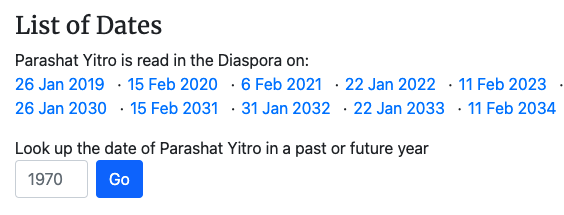
If you enter those 10 years (1918 through 1928) you should be able to get the dates (both Gregorian and Hebrew) pretty quickly.
Hi Ben, it can take up to 7 days for Google Calendar to refresh iCalendar subscription feeds.
For good measure, we just cleared our server-side cache to sometime within the next week when Google refreshes you should definitely see the updates.
Update: we've added a Yom Kippur Katan calendar feed to the Hebcal website. You can find it towards the bottom of the Jewish holiday downloads page.
Yom Kippur Katan
יוֹם כִּפּוּר קָטָן is a minor day of atonement occurring monthly on the day preceeding each Rosh Chodesh.
9 calendar events per year. 10-year perpetual feed.
Yom Kippur Katan is omitted in Elul (on the day before Rosh Hashanah), Tishrei (Yom Kippur has just passed), Kislev (due to Chanukah) or Nisan (fasting not permitted during Nisan). When Rosh Chodesh occurs on Shabbat or Sunday, Yom Kippur Katan is observed on the preceding Thursday. [1]
Outlook CSV
iCalendar link:
Customer support service by UserEcho

Correct, these flags are available in the JavaScript API, but currently not available in the REST api.
Shana Tova!