
 chovetz chaim calednar bug (shows xx's on some days). Hebrew months displayed at the top?
Bs"D. Note that i checked the chovetz chaim box with the tehillim box. also, is there a way to have the Hebrew months displayed at the top instead of Gregorian (Jan, Feb, etc)? even if i check the box "Hebrew year" or "Israeli holiday schedule" it doesn't show when i go to "print." I'd like the calendar to display at the top "Shevat 5784, Adar, etc" . thanks Baruch Hashem



Hi, thanks for your message!
We are not AppSheet experts. Have you tried bringing Hebcal data into Google Calendar, and then from Google Calendar into AppSheet?
https://support.google.com/appsheet/answer/10106764?hl=en#add-data-source
https://www.hebcal.com/home/60/google-calendar-jewish-holidays

Hi, thanks for your message. We're not sure what you mean by glitch? The web page looks correct to us.
https://www.hebcal.com/converter?gd=20&gm=6&gy=2024&g2h=1
Thu, 20 June 2024 = 14th of Sivan, 5784
י״ד בְּסִיוָן תשפ״ד
When you click on the parsha link, it takes you to the Torah reading for that week which is Parashat Beha’alotcha. The date listed on the Parashat Beha’alotcha page is always the Shabbat that the parsha is read... in this case, it is Saturday, 22 June 2024.
If you see a page that incorrectly has the date June 26 on it, could you send the URL and/or a screenshot?

Thanks for using the Hebcal date converter.
Unfortunately, no, we do not offer a timezone parameter or another web API to determine the Hebrew date based on the current date in a timezone.
You can do this in JavaScript using our Zmanim JavaScript API using something like the following code
const {Location, Zmanim, HDate} = require('@hebcal/core');
const location = Location.lookup('Boston');
const now = new Date();
const zmanim = new Zmanim(location, now, false);
const sunset = zmanim.sunset();
let hd = new HDate(now);
if (now >= sunset) {
  hd = hd.next();
}
 seems like the haftarah for Parashat Shekalim for Sefardi tradition is wrong. i
t's listed as Haftarah for Vayakhel, but according to mu siddur there is a Sefardi specific haftarah .
Thanks, this is very helpful! We have fixed the web pages. The corrected reading appears in both of these places:
https://www.hebcal.com/sedrot/vayakhel-20240309
https://www.hebcal.com/holidays/shabbat-shekalim-2024#reading
Haftarah for Ashkenazim*: II Kings 12:1-17 · 17 p’sukim
*Shabbat Shekalim
Haftarah for Sephardim*: II Kings 11:17-12:17 · 21 p’sukim
*Shabbat Shekalim

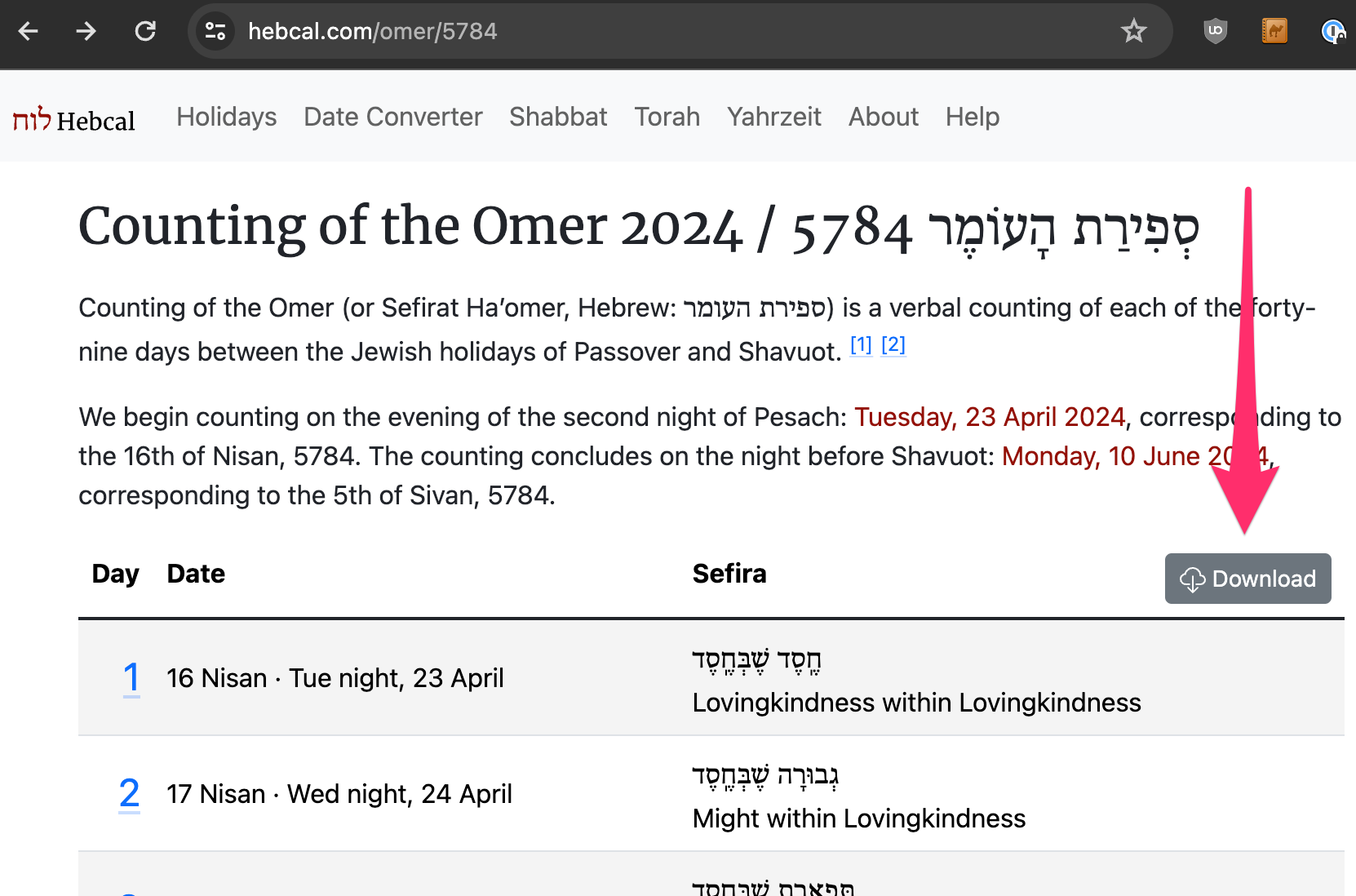
Is there a way to subscribe / download the Omer calendar?
i found the omer calendar for 2024 but I don't see a way to download or subscribe to it. Am I missing something?
Thanks for your message! You can find the Omer calendar download/subscription feed here:
We have also added a download button to that page to make it easier to download/subscribe to a calendar feed if you are already on the Omer page.

On behalf of Hebcal.com, thanks for your willingness to make a donation! We really appreciate your support.
Unfortunately, we cannot accept paper check donations. We can only receive donations via PayPal and Venmo.
Thank you also for choosing Hebcal for your Jewish holiday and calendar needs! If you have any ideas or suggestions for how we could continue to improve Hebcal, we’d love to hear from you.
Happy Gregorian New Year!

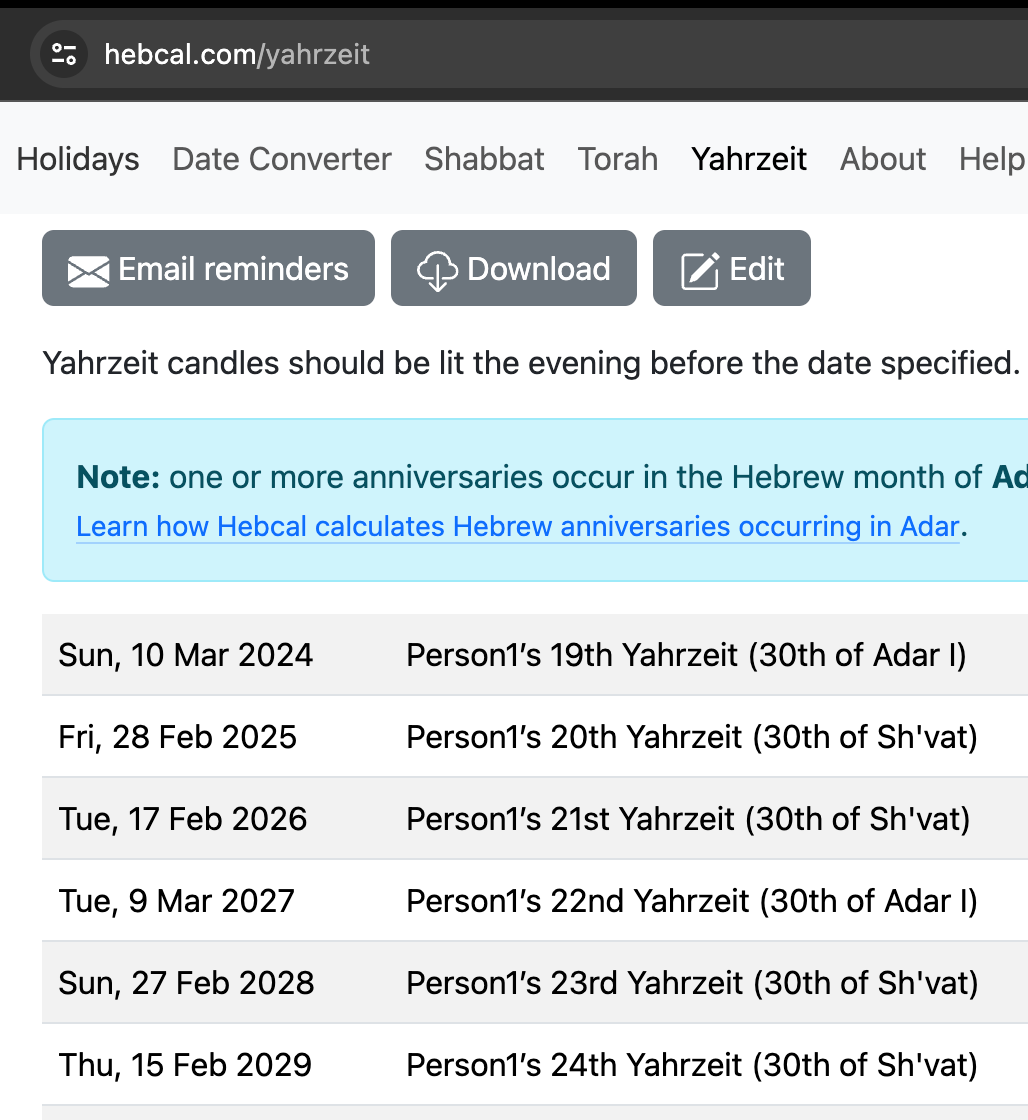
Yahrzeit on 30 Adar I
For a yahrzeit that occurs on 30 Adar I 5760, Hebcal produces a table showing the yahrzeit occurring on 1 Nisan in non-leap years. Yet the discussion at https://www.hebcal.com/home/54/anniversaries-adar-cheshvan-kislev seems to say that it should be on the last day of Shevat (30 Shevat) in non-leap years. I've attached a screen shot of what I see.
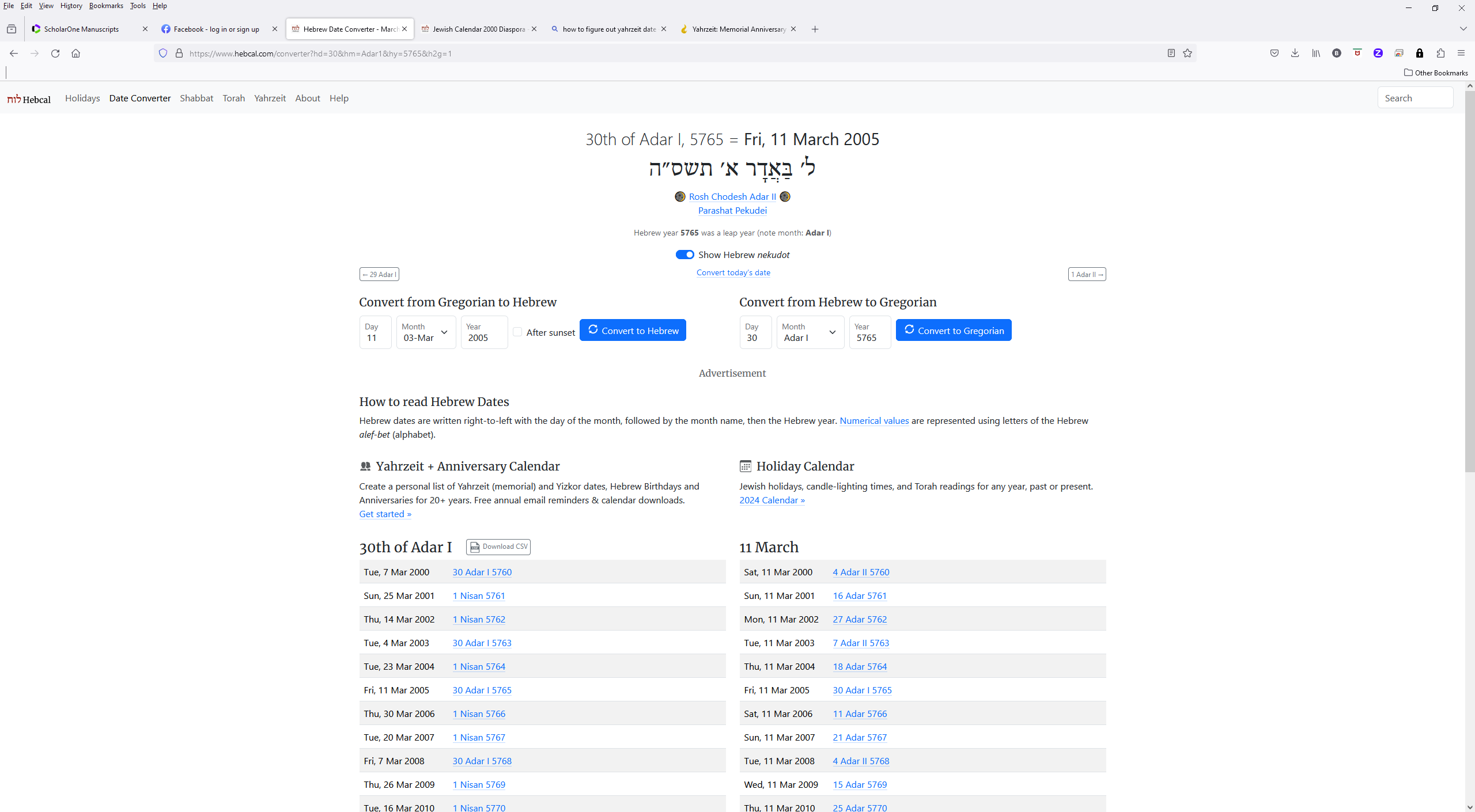
Have I misunderstood something? BTW, Chabad shows me an anniversary calendar with the yahrzeit on 30 Shevat in non-leap years.
Hi, thanks for contacting Hebcal.
To calculate yahrzeit dates, please use our Yahrzeit + Anniversary Calendar page. You will note that if you enter 11-March-2005 you will get the Ashkenazic practice for 30 Adar I.
Thank you for posting a screenshot from our simple Hebcal Hebrew Date converter. The Hebrew Date Converter page does not follow the special rules for a yahrzeit.
Customer support service by UserEcho